When Reporters Cross the Line by Stewart Purvis
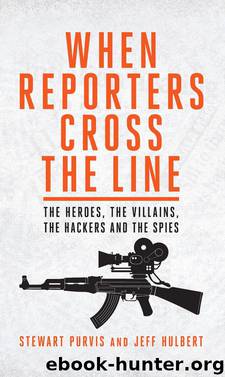
Author:Stewart Purvis [Stewart Purvis and Jeff Hulbert]
Language: eng
Format: epub, mobi
ISBN: 9781849546461
Publisher: Biteback Publishing
Published: 2013-11-20T16:00:00+00:00
The BBC agreed with the British government that the first mention of the conflict in any news story would never refer to ‘Biafra’, which might imply some recognition of it as a sovereign state, but a form of words such as ‘the breakaway south-eastern region which calls itself Biafra’. This didn’t exactly trip off the tongue.
All the BBC’s written archives are kept in a small building on the outskirts of Reading. In the files on Nigeria there are many examples of the tension between broadcaster and government throughout the Biafran conflict from 1967 to 1970. The most regular complainant was the British High Commissioner in Nigeria, Sir David Hunt, better known a few years later as a winner of the BBC’s Mastermind competition. But at this point his preoccupation with the BBC was the output of its overseas radio services. He concluded one complaint letter to the BBC with this comment on those services: ‘They announced last week that the Duke of Edinburgh was going to visit West Africa. The news roused great excitement here as you can well imagine. When people discover that it is quite false it will be another nail in the coffin of the BBC’s credibility.’498
Into this kind of stressful atmosphere in July 1967 stepped 29-year-old Frederick Forsyth. He had joined the BBC in 1965 after four years as a Reuters foreign correspondent, including a period as the Reuters man in France and East Germany. The BBC files report his promotion in January 1967 to ‘Foreign Correspondent, London-based’.499 In the summer of that year the BBC decided that in addition to having its correspondent in the federal capital, Lagos, it needed to send a reporter to cover the area controlled by the Biafrans. Forsyth was chosen and before he was sent it was decided that he needed a proper briefing about Biafra, its people (who were mostly from the Ibo tribe) and its controversial leader, Colonel, later General, Ojukwu.
Forsyth later recalled, ‘The briefing basically was that the secession of Biafra – the eastern region – from Nigeria was being forced upon the people by the ruthlessly ambitious Ojukwu.’ He says he was told ‘that they were perfectly happy under the Nigerian dictatorship and the prediction was that the magnificent and British-trained, largely Hausa, Nigerian army would invade and sweep through’.
Forsyth’s initial experiences in Biafra were rather different:
What I got there to find was that the people were massively in favour of secession, that the restraining influence had been Ojukwu and far from sweeping through, there was absolutely no military movement whatever.
I discovered absolutely everything I had been told was rubbish. Being naive (not about reporting, I had been four years with a far better outfit called Reuters, but about the BBC mindset) I reported this. Outrage, horror, he must be biased. Asked to recant, I repeated what I was seeing – no federal victories.500
Starting with our High Commissioner in Lagos and moving up through the Commonwealth Office, the Wilson government adopted a passionately pro-Lagos view and imparted this to the BBC.
Download
When Reporters Cross the Line by Stewart Purvis.mobi
This site does not store any files on its server. We only index and link to content provided by other sites. Please contact the content providers to delete copyright contents if any and email us, we'll remove relevant links or contents immediately.
The Brazilian Economy since the Great Financial Crisis of 20072008 by Philip Arestis Carolina Troncoso Baltar & Daniela Magalhães Prates(131247)
International Integration of the Brazilian Economy by Elias C. Grivoyannis(106922)
The Art of Coaching by Elena Aguilar(53123)
Flexible Working by Dale Gemma;(23280)
How to Stop Living Paycheck to Paycheck by Avery Breyer(19680)
The Acquirer's Multiple: How the Billionaire Contrarians of Deep Value Beat the Market by Tobias Carlisle(12297)
Thinking, Fast and Slow by Kahneman Daniel(12196)
The Radium Girls by Kate Moore(11997)
The Art of Thinking Clearly by Rolf Dobelli(10373)
Hit Refresh by Satya Nadella(9099)
The Compound Effect by Darren Hardy(8901)
Tools of Titans by Timothy Ferriss(8343)
Atomic Habits: Tiny Changes, Remarkable Results by James Clear(8301)
Turbulence by E. J. Noyes(7998)
A Court of Wings and Ruin by Sarah J. Maas(7771)
Change Your Questions, Change Your Life by Marilee Adams(7713)
Nudge - Improving Decisions about Health, Wealth, and Happiness by Thaler Sunstein(7676)
How to Be a Bawse: A Guide to Conquering Life by Lilly Singh(7454)
Win Bigly by Scott Adams(7163)
